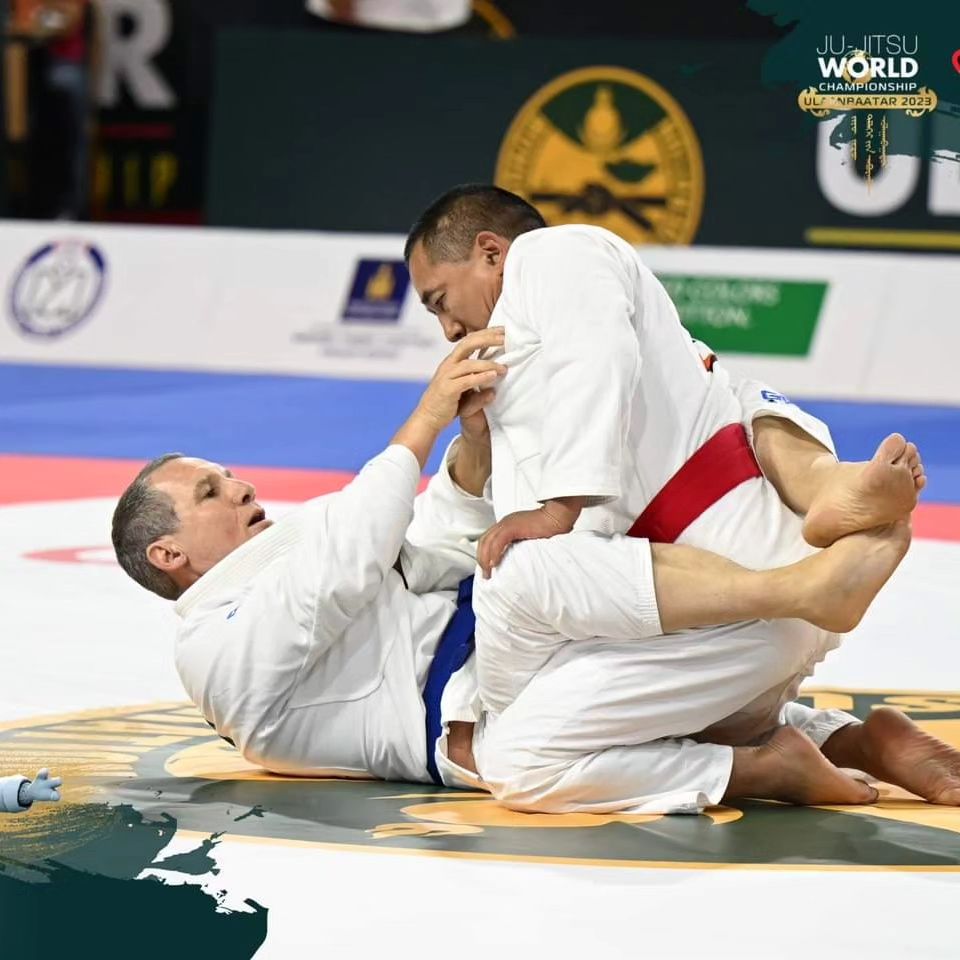
Ne Waza (Ground Game) Rules
Ground-focused grappling where the highest objective is victory via submission.
JJIF Jujitsu (Ne-Waza) Rules V2.8 — 2026 Update
Discipline Overview
With emphasis on grappling on the ground (ne-waza), the highest objective in Jujitsu competition is to win via submission — inducing surrender from the opponent using a legal choke or lock. For matches that don't end in submission, an official scoring system rewards the technical application of Jujitsu through a progression of scoring advancements and control positions. The competition attire can use either the traditional Gi or an officially approved No Gi kit of rash guards and shorts.
Primary Objectives
- Win via submission using a legal choke or joint lock.
- If no submission: win by accumulating points through takedowns, sweeps, guard passes, and control positions.
- Earn advantages for near-scoring attempts to break ties when points are equal.
Field of Play
The match area is designed for athlete safety with clearly defined zones.
Total Match Area
At least 10m × 10m, composed of protective mats in two colours to distinguish the fighting area from the safety area.
Fighting Area
The central competition zone where scoring actions take place.
Safety Area
An outer layer of differently coloured mats extending at least one square metre outward from the fighting area in all directions.
Competition Dress — Gi & No Gi
Athletes may compete in Gi or No Gi format, each with specific uniform requirements.
Gi Format
Clean white cotton woven jujitsu Gi of good quality. Rip-stop material is not allowed for the jacket. Red and blue belts worn to identify competitors.
No Gi Format
Rash guard and shorts with no zippers, buttons, or hard materials. Pockets must be sewn shut. Rash guards may not be a mix of red and blue.
Undergarments
Elasticated undergarments required. Compression leggings permitted (plain black or white for Gi; matching rash guard colour for No Gi).
Permitted Supports
Soft elastic knee/ankle/shoulder/elbow supports, sports-quality hijab in female divisions, and athletic tape applied directly to skin.
Scoring System
Points are awarded for achieving and maintaining positional control, as well as for takedowns and sweeps.
Takedown
Bringing the opponent from standing to the ground while maintaining control.
Sweep
Reversing position from the guard to a dominant position.
Guard Pass
Moving past the opponent's legs from a defensive guard to a dominant position.
Knee on Belly
Placing one knee on the opponent's torso while maintaining balance and control.
Full Mount
Sitting astride the opponent's torso with both knees on the ground.
Back Control
Taking control of the opponent from behind with hooks (heels) inserted.
Fouls & Prohibited Acts
Penalties escalate from minor fouls to disqualification, with specific prohibited techniques varying by belt rank.
Minor Fouls
Technical infractions such as stalling, delaying the match, or fleeing the competition area. Penalised with advantages to the opponent.
Disciplinary Major Fouls
Unsportsmanlike conduct or repeated minor fouls. Result in point deductions or disqualification.
Technical Major Fouls
Illegal techniques that endanger the opponent, including prohibited joint locks and chokes.
Knee Reaping
Crossing the leg line during certain leg lock attempts — a serious foul that can result in disqualification depending on intent and position.
Coaches & Conduct
One Coach Per Athlete
Only one coach may accompany each athlete from the boundary of the match area, remaining seated unless issuing a video replay challenge.
No Electronic Devices
Coaches may not use mobile phones, take photos/videos, or use any electronic devices at the field of play.
Dress Code
Team tracksuit during elimination; smart dress for finals. No hats permitted.
Communication
Athletes may not speak to their coach during the match — doing so results in a penalty.
Next Discipline
Duo