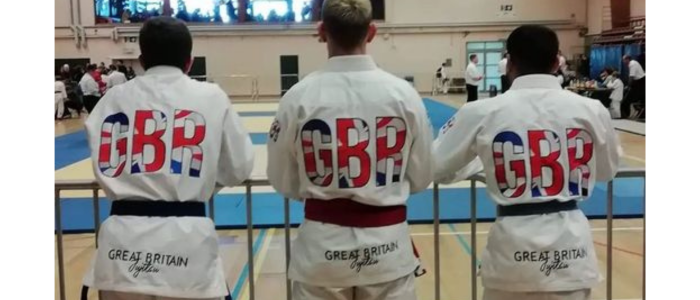
Duo
A self-defence demonstration discipline where two athletes defend as a team against predetermined attacks.
JJIF Duo Jujitsu Rules V4.2.1
Discipline Overview
The JJIF Duo System is aimed at presenting the defence of several predetermined attacks performed by two athletes of the same team. Unlike fighting disciplines, Duo is a demonstration discipline — the two athletes take turns as attacker and defender, performing a series of 20 standardised attacks and defences. A panel of referees evaluates each performance based on technical quality, realism, power, speed, and balance.
Primary Objectives
- Demonstrate effective, technically correct defence against all predetermined attacks.
- Achieve the highest combined score from the referee panel across all performances.
- Maintain realism, control, and sportsmanship throughout the demonstration.
How Duo Works
The Duo System is a team-based demonstration with a structured format.
Two-Athlete Team
Two athletes of the same team perform together, alternating roles as attacker and defender across the series of attacks.
20 Predetermined Attacks
A fixed series of 20 attacks (listed in Appendix 1 of the rulebook) covering grabs, chokes, punches, kicks, and weapon threats.
Alternating Roles
Each athlete performs as both attacker and defender, with roles alternating to ensure both are evaluated in both capacities.
Team Competition
Duo can be contested as individual pairs or as part of a team competition format.
Competition Dress
Duo competitors follow the same dress code principles as other JJIF disciplines.
Gi
A JJIF-homologated Gi, clean and in good condition, following Sporting Code specifications.
Belts
Red and blue belts worn to distinguish the two athletes.
Personal Requirements
Short fingernails and toenails; long hair tied with a soft band. No jewellery or items that could cause injury.
Protective Gear
Minimal protective gear compared to contact disciplines — Duo is a controlled demonstration.
Scoring Criteria
The referee panel evaluates each defence against multiple performance criteria.
Technical Quality
Correctness and precision of the defensive techniques applied against each attack.
Realism
The demonstration must reflect genuine, effective self-defence — not choreographed theatre.
Power & Control
Techniques must be executed with appropriate force while maintaining control and safety for both athletes.
Speed & Balance
Fluid, timely execution with proper balance maintained throughout each defence.
Refereeing & Evaluation
Referee Panel
A panel of referees scores each performance independently, with the highest and lowest scores typically dropped to calculate the final.
Mat Referee
The Mat Referee conducts the demonstration and manages the sequence of attacks.
Challenge System
Referee decisions may be challenged according to JJIF Sporting Code regulations.
Tie-Breaking
If teams are tied, the tie is broken using the detailed scores from specific evaluation criteria.
Attack Categories
The 20 predetermined attacks span a range of self-defence scenarios.
Grabs & Holds
Various grabs to the wrist, clothing, throat, and body from different angles.
Chokes & Strangulations
Standing and seated choke attempts from multiple positions.
Punches & Strikes
Direct punches, hooks, and strikes from different angles and stances.
Kicks & Weapons
Kicking attacks and threats with weapons such as knives, sticks, and pistols.
Next Discipline
Combat Jujitsu