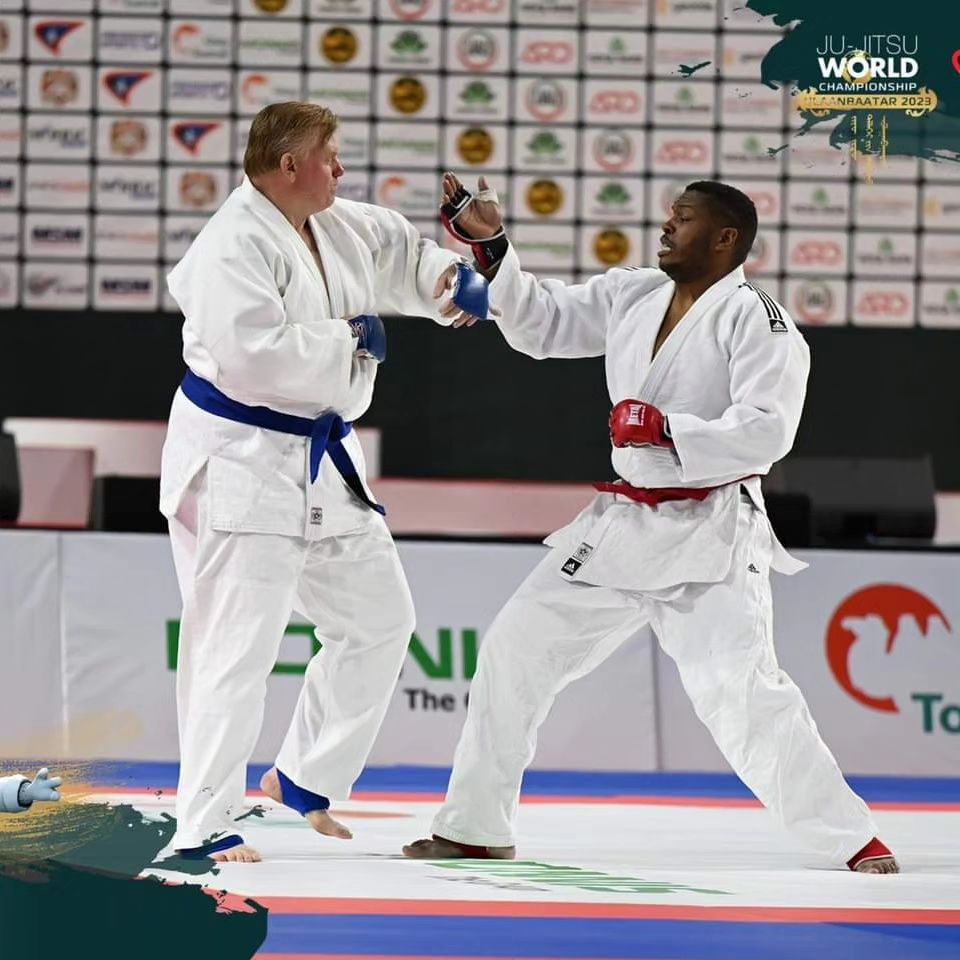
Fighting Jujitsu
The flagship JJIF Fighting System — a three-part match combining strikes, throws, and ground control.
JJIF Fighting Rules 2026 (V4.0+)
Discipline Overview
In the JJIF Fighting System, two competitors face each other in a sportsmanlike contest. The objective is to win by full-ippon — scoring a perfect technique across all three parts of the match — or by outscoring your opponent. The match flows through three distinct parts: Part 1 (strikes and kicks), Part 2 (throws and submission holds), and Part 3 (ground control and submissions).
Primary Objectives
- Win by full-ippon: score a perfect technique in Part 1, Part 2, and Part 3.
- If no full-ippon is achieved, win by accumulating more points than the opponent across all three parts.
- Competitors must actively attempt to score in all parts; passivity is penalised.
The Three Parts of the Match
A Fighting System match is composed of three sequential parts, each with its own permitted techniques and scoring criteria.
Part 1 — Atemis
Punches, strikes, and kicks. The match starts here and restarts from Part 1 whenever the action is stopped or grips are broken.
Part 2 — Takedowns & Submissions
Begins when a grip is established. Atemis are forbidden except simultaneously with the initial grip. Scores come from throws, takedowns, and submission holds.
Part 3 — Ground Control
Begins when both competitors have both knees on the ground, or one is sitting or lying. Atemis and takedowns are not scored. Points come from osae-komi (pins) and submission holds.
Match Duration & Recovery
Adults, U21, U18 & U16
3 minutes per match.
Masters, U14 & Younger
2 minutes per match.
Recovery Between Matches
5 minutes between matches; 10 minutes before final fights.
Competition Dressing & Equipment
All competitors must meet JJIF dress and safety standards before being allowed to compete.
Gi
A JJIF-approved Gi following Sporting Code specifications. Female competitors must wear a white leotard or rash guard under the jacket; males may choose to.
Hand & Foot Protection
Soft, short, and light hand protections and soft foot/shinbone protections matching the belt colour (red or blue), 1–2 cm foam thickness.
Mouthpiece & Jockstrap
Mouthpieces are required for U18 and younger; jockstraps required for males in those categories. Mouthpieces and jockstraps are permitted for all.
Hygiene & Safety
Short fingernails and toenails; long hair tied with a soft band. No items that could injure or endanger anyone.
Refereeing Structure
Fighting System matches are officiated by a team of referees using video replay.
Mat Referee (MR)
Stays within the match area, conducts the match, and is the sole authority on scoring and penalty decisions.
Video Referees (VRs)
Two VRs situated at the secretariat review actions leading to injury or full-ippon, using two cameras at opposite corners.
Table Referee (TR)
Oversees the secretariat, announces points/penalties, and manages injury-time.
Tatami Head Referee (HR)
Supervises and evaluates the MR and VRs, keeps records, and reviews direct hansoku-make actions.
Penalties & Fouls
Fouls are categorised by severity, with escalating consequences.
Minor Fouls
Technical infractions and rule violations that do not endanger the opponent. Punished with shido (penalty points to the opponent).
Major Fouls
More serious violations that may endanger the opponent or violate the spirit of the sport. Punished with chui or heavier penalties.
Severe Fouls
Dangerous or intentional violations resulting in hansoku-make (disqualification).
Next Discipline
Ne Waza (Ground Game)